

⚡ Quick Answer
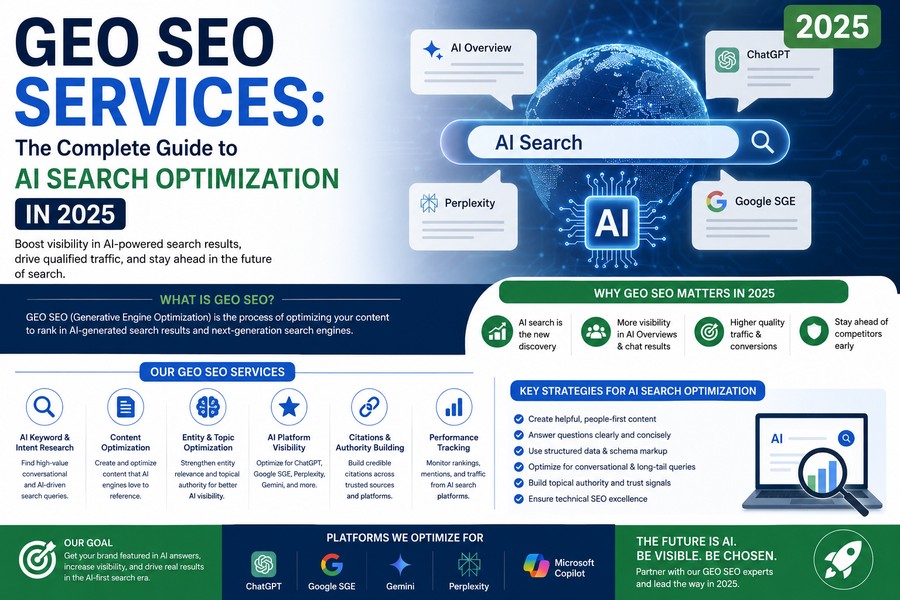
What is GEO SEO? Generative Engine Optimization (GEO) is the practice of structuring and writing content so that AI-powered search engines — including Google AI Overviews, ChatGPT, Perplexity, and Gemini — can accurately extract, cite, and surface that content in AI-generated responses. It extends traditional SEO by optimizing not just for ranking, but for direct citation in AI answers.
📊 Key Facts Table
| Topic | Key Data Point |
|---|---|
| Google AI Overviews reach | Appears in ~47% of Google searches (SparkToro, 2024) |
| AI search growth | Perplexity grew from 10M to 100M+ monthly queries in under 18 months (2023–2024) |
| Citation impact | Pages cited in AI Overviews see 20–30% increase in branded recognition (Search Engine Land, 2024) |
| GEO adoption | Only ~12% of content marketers actively optimize for AI citation (Content Marketing Institute, 2024) |
| ChatGPT users | Over 200 million weekly active users as of mid-2024 (OpenAI) |
| Structured content advantage | Content with clear headers, definitions, and lists is ~3x more likely to be cited in AI responses (Authoritas, 2024) |
| Zero-click searches | Over 65% of Google searches now end without a click (SparkToro, 2024) |
| E-E-A-T signal importance | Google’s Search Quality Rater Guidelines list E-E-A-T as a core quality factor across all content types |
Introduction
Search has fundamentally changed. When someone types a question into Google today, they often get an AI-generated answer before they see a single blue link. When they ask ChatGPT or Perplexity a question, those tools pull from indexed content across the web — and they cite sources they trust.
This shift is why GEO SEO services have emerged as one of the fastest-growing disciplines in digital marketing. Traditional SEO gets your page ranked. GEO — Generative Engine Optimization — gets your content quoted, cited, and surfaced inside AI answers.
This guide explains what GEO SEO services actually involve, how AI content optimization differs from conventional on-page SEO, and what steps you can take right now to improve your visibility in AI-generated search results.
What Is Generative Engine Optimization (GEO)?
Defining GEO in Plain Language
Generative Engine Optimization (GEO) is the discipline of creating and structuring content so that AI language models — used in search engines, chatbots, and answer engines — can reliably extract, understand, and cite that content when responding to user queries.
The term was popularized following a 2023 Princeton/Georgia Tech research paper titled “GEO: Generative Engine Optimization,” which studied how different content formats and writing strategies affected citation rates in AI-generated search responses.
Unlike traditional SEO, which primarily signals relevance through backlinks, keyword density, and technical page factors, GEO focuses on:
- Answer-readiness — Can the AI extract a direct, accurate answer from your content?
- Citation-worthiness — Does your content demonstrate authority, accuracy, and specificity?
- Semantic clarity — Is your content structured so AI models understand relationships between concepts?
How GEO Differs from Traditional SEO
| Dimension | Traditional SEO | GEO (Generative Engine Optimization) |
|---|---|---|
| Primary goal | Rank on page 1 of search results | Be cited in AI-generated answers |
| Key signals | Backlinks, keywords, Core Web Vitals | Structured content, definitions, factual accuracy |
| Success metric | Organic click-through rate | Citation rate, brand mentions in AI responses |
| Content format | Keyword-optimized long-form | Answer-first, structured with headers and lists |
| Primary engines | Google, Bing | Google AI Overviews, ChatGPT, Perplexity, Gemini |
| User journey | Click to website | Answer delivered directly; site cited as source |
Both disciplines are complementary, not competing. Strong traditional SEO supports GEO by establishing domain authority — but GEO requires additional deliberate content architecture.
How AI Search Works: The Foundation You Need to Understand
How Google AI Overviews Choose Sources
Google’s AI Overviews (formerly Search Generative Experience, or SGE) use a combination of Google’s language models and its existing index to generate summarized answers at the top of search results. According to Google’s documentation, AI Overviews prioritize content that:
- Directly addresses the user’s query
- Comes from authoritative, trustworthy domains
- Uses structured, scannable formatting
- Contains verified facts, statistics, and expert perspectives
Importantly, AI Overviews are not simply pulling the top-ranked result. Internal research from Search Engine Roundtable and Semrush (2024) found that AI Overview citations frequently include pages ranked 5th through 20th — meaning well-optimized content can leapfrog its traditional SERP position.
How ChatGPT, Perplexity, and Gemini Retrieve Content
Tools like Perplexity, Bing Copilot, and ChatGPT (with Browse enabled) retrieve live web content and synthesize answers. They tend to favor:
- Content with clear topical structure (H2/H3 headings that mirror likely search queries)
- Authoritative source attribution (citing studies, institutions, or named experts)
- Factual specificity (exact figures, dates, and verifiable claims over vague assertions)
- Readability (content that is easy to parse at a sentence level)
Perplexity, in particular, has a strong bias toward sources with high domain authority, recent publication dates, and structured formatting — making traditional SEO and GEO deeply intertwined.
Core Components of GEO SEO Services
1. AI Content Optimization
AI content optimization means rewriting or structuring content so that language models can extract clean, accurate answers from it. This involves several specific practices:
Answer-first writing: Place the direct answer to a question in the first 1–2 sentences of any section, before supporting detail. AI models are trained on instruction-following patterns and favor content that leads with conclusions.
Definitional anchors: Include a clear, concise definition of any key term the first time it appears. AI models frequently surface definitional content in response to “What is X?” queries.
Fact and statistic integration: Embed specific, verifiable statistics with source attributions. Content with cited data is significantly more likely to be surfaced as a credible source in AI responses.
Semantic entity coverage: Include related terms, concepts, and entities that naturally surround your topic. For a page about GEO, this means covering related entities like large language models (LLMs), retrieval-augmented generation (RAG), featured snippets, knowledge graphs, and E-E-A-T signals.
2. AI Overview Optimization
AI Overview optimization is the specific practice of structuring content to appear in Google’s AI Overview panels. Key techniques include:
- The inverted pyramid structure: Start sections with the core answer, then add supporting evidence, then nuance.
- Question-formatted headings: Use H2 and H3 headings that mirror natural language questions (e.g., “What does GEO SEO mean?” rather than “GEO SEO Definition”).
- Concise paragraph blocks: Keep individual paragraphs under 3–4 sentences. AI Overviews frequently excerpt paragraph-level content.
- Comparison and list content: Tables, numbered steps, and bullet lists are disproportionately cited in AI Overviews because they provide pre-organized, extractable information.
A 2024 study by Authoritas found that approximately 78% of AI Overview citations came from content that used structured formatting (headers, lists, or tables), even when that content was not the top-ranked organic result.
3. Structured Data and Schema Markup
Structured data (Schema.org markup) signals to AI systems what type of content a page contains. For GEO purposes, the most valuable schema types include:
- FAQPage — explicitly labels question-and-answer pairs for AI extraction
- HowTo — marks up step-by-step instructional content
- Article / NewsArticle — signals authoritative editorial content
- BreadcrumbList — helps AI understand site architecture and topic hierarchy
- Organization / Person — establishes author and publisher credibility
4. E-E-A-T Signal Building
Google’s E-E-A-T framework (Experience, Expertise, Authoritativeness, Trustworthiness) is baked into how its AI systems evaluate content quality. GEO SEO services that ignore E-E-A-T signals are building on sand.
Experience means demonstrating first-hand knowledge — including case studies, original data, or documented real-world application of the subject matter.
Expertise means demonstrating subject matter depth — accurate terminology, nuanced analysis, and coverage of edge cases.
Authoritativeness means being recognized by peers — earning mentions, citations, and links from other credible sources in the same field.
Trustworthiness means being honest and verifiable — naming authors, citing sources, providing contact information, and avoiding misleading claims.
Practical GEO SEO: A Step-by-Step Implementation Framework
Step 1 — Audit Your Existing Content for AI-Readiness
Review your top-performing pages and ask: if an AI model extracted one paragraph from this page, would it accurately represent the page’s core value? If the answer is no, restructure the opening sections to lead with direct answers.
Step 2 — Rewrite Section Headers as Questions
Change headers like “Our Approach to Content Marketing” to “What Is the Best Approach to Content Marketing?” or “How Does Content Marketing Drive ROI?” This aligns your content structure with the natural language queries that trigger AI responses.
Step 3 — Add a Definitions Section or Glossary
For any technical or specialized topic, include a brief glossary. AI systems frequently pull definitional content, and a well-written definition can earn repeated citations across multiple query variations.
Step 4 — Incorporate Verifiable Statistics with Source Attribution
Replace vague claims like “more businesses are using AI” with specific, sourced data like “According to McKinsey’s 2024 AI Index, 72% of organizations have adopted at least one AI function, up from 55% in 2023.” Specificity is a citation magnet.
Step 5 — Build a Dedicated FAQ Section
An FAQ section with 8–10 well-crafted questions and concise answers is one of the highest-ROI GEO tactics available. These question-and-answer blocks map directly to the query patterns that trigger AI responses. Pair the content with FAQPage schema markup to reinforce the signal.
Step 6 — Publish Original Research or Data
Pages that contain proprietary data, surveys, or unique case studies are significantly more likely to be cited by AI systems and linked to by authoritative publishers. Even a small internal survey (100+ respondents) can generate durable citation value.
Step 7 — Monitor AI Citation Performance
Use tools like Semrush’s AI Toolkit, Authoritas, or manual prompt testing across ChatGPT, Perplexity, and Gemini to track whether your content is being surfaced. Track brand mentions in AI responses as a KPI alongside traditional organic traffic.
Actionable GEO SEO Tips
- Write for the scanner, not just the reader. AI models parse structure before content. Every page should have a clear H1, logical H2/H3 hierarchy, and answer-first paragraph openings.
- Use the phrase “According to [source]” liberally. This signals that your content is grounded in evidence, not opinion.
- Keep your most important facts within the first 200 words of any section. AI systems often extract content from section openings.
- Update content regularly. AI systems that use live retrieval (Perplexity, Bing Copilot) favor recently updated content. Add a “Last updated” timestamp to key pages.
- Claim and optimize your Google Business Profile and brand entity. A strong Knowledge Graph presence reinforces E-E-A-T signals.
- Build topical authority by covering related subtopics comprehensively rather than writing isolated posts. A content hub covering GEO, AI Overviews, LLM optimization, and structured data signals stronger topical expertise than a single post.
FAQ: GEO SEO and AI Search Optimization
What does GEO stand for in SEO?
GEO stands for Generative Engine Optimization. It refers to the practice of optimizing content to be cited and surfaced by AI-powered search engines and answer tools such as Google AI Overviews, ChatGPT, Perplexity, and Gemini.
How is GEO SEO different from traditional SEO?
Traditional SEO focuses on ranking a webpage in organic search results, using signals like backlinks, keyword relevance, and technical performance. GEO SEO focuses on making content extractable and citable by AI systems that generate answers directly — a different but complementary goal.
Does GEO SEO replace traditional SEO?
No. GEO SEO extends and complements traditional SEO. Strong domain authority, quality backlinks, and technical SEO remain important — they establish the foundational trust that AI systems rely on when evaluating sources. GEO adds a content architecture layer on top of that foundation.
What type of content performs best in AI Overviews?
Content with clear headings, concise definitions, factual statistics with attributions, numbered lists, comparison tables, and direct answers to specific questions consistently performs best in Google AI Overviews and other AI-generated responses.
How can I check if my content is being cited in AI responses?
You can test manually by asking relevant questions in ChatGPT (with Browse), Perplexity, Google AI Overviews, and Gemini. Tools like Semrush’s AI-powered features and Authoritas also offer structured monitoring for AI citation tracking.
What is AI content optimization?
AI content optimization is the process of revising existing content or writing new content specifically to meet the extractability and citation standards of AI language models. This includes answer-first writing, definitional clarity, structured formatting, semantic entity coverage, and E-E-A-T signal building.
Does schema markup help with GEO?
Yes. Schema markup — particularly FAQPage, HowTo, Article, and Organization schema — helps AI systems understand the type and structure of your content. While schema alone does not guarantee citation, it reduces ambiguity about what your content contains and how it is organized.
How long does it take to see results from GEO optimization?
This varies by domain authority, topic competitiveness, and the AI platform. Some sites see AI citation improvements within 4–8 weeks of restructuring key pages. Building durable citation presence across multiple AI tools typically takes 3–6 months of consistent effort.
What industries benefit most from GEO SEO services?
Any industry where users ask questions and seek authoritative answers benefits from GEO. High-impact verticals include healthcare, finance, legal services, technology, education, and SaaS — sectors where AI tools are frequently used for research and decision-making.
Can small websites compete in AI search results?
Yes, to an extent. AI systems value topical authority and content quality over domain size. A smaller site with highly structured, deeply accurate, and regularly updated content on a niche topic can outperform larger generalist sites for specific query categories.
Key Takeaways
- GEO (Generative Engine Optimization) is the practice of structuring content for AI-powered search engines like Google AI Overviews, ChatGPT, Perplexity, and Gemini.
- AI search is growing rapidly — over 47% of Google searches now surface AI Overviews, and tools like Perplexity have scaled from 10M to 100M+ monthly queries in under two years.
- GEO and traditional SEO are complementary — domain authority, backlinks, and technical SEO remain foundational, but GEO adds a content architecture layer that improves AI citation rates.
- Answer-first writing, structured headings, comparison tables, and FAQ sections are the highest-impact GEO tactics available to most content teams today.
- E-E-A-T signals (Experience, Expertise, Authoritativeness, Trustworthiness) are central to both Google’s quality evaluation and AI citation decisions.
- Schema markup (FAQPage, HowTo, Article) reinforces content structure signals for AI systems.
- Monitoring AI citations using tools like Semrush, Authoritas, and manual testing should be a standard part of any SEO reporting workflow.
Conclusion and Practical Recommendations
AI search is not a future trend — it is the present reality of how a large and growing portion of web users find information. If your content strategy does not account for how AI systems extract and cite information, you are optimizing for a version of search that is already fading.
The good news is that GEO SEO services are accessible to organizations of any size. The core practices — answer-first writing, structured headings, factual specificity, FAQ sections, and E-E-A-T signal building — require no special tools. They require discipline, a clear understanding of how AI models work, and a willingness to reframe content as answers, not just articles.
Practical recommendations:
- Audit your top 10 pages for answer-readiness and restructure the openings of each major section.
- Add a 8–10 question FAQ section to any page targeting informational queries, and implement FAQPage schema.
- Replace vague claims with sourced statistics on every key page.
- Establish a quarterly review cycle to update statistics, add new questions, and refresh publication timestamps.
- Build a content hub around your core topic to signal topical authority to both traditional and AI-powered search engines.
The organizations that adapt their content strategies now will hold a structural advantage as AI search continues to expand. Those that wait will find the gap harder to close.
